5 Best Welding Boots Reviewed (Real Welder Picks) [2026]


| Boot | Toe Type | Met Guard | EH Rated | Waterproof | Heat Resistance | Best For |
|---|---|---|---|---|---|---|
| Wolverine Floorhand 6″ | Steel | No | Yes | Yes | Standard | Budget / Everyday shop |
| SAFETOE Composite Toe | Composite | No | Yes | No | 300°C rated | High-heat welding |
| SAFETOE w/ Met Guard | Composite | Yes | Yes | No | 300°C rated | Full foot protection |
| Timberland PRO Ext. Met Guard 8″ | Steel | Yes (external) | Yes | Yes | High-rated rubber | Premium / Max protection |
| Timberland Direct Attach 6″ Insulated | Steel | No | Yes | Yes | Standard | Cold weather / Outdoor welding |
If you’ve ever been on a long shift at work, welding for several hours, dealing with sparks and hot slag, you know how tired and stressed your legs can be. The problem is that most welders treat their boots like an afterthought and just get the cheapest option.
I did this once and paid for it big time. In the end, the boots didn’t last, and worse, I ended up making multiple trips to my chirroprator wondering why my back was always hurting so much, only to realize it was the welding boots I was wearing. So what are the best welding boots?
I’ve dug into five of the best welding boots on the market right now — from budget-friendly options to heavy-duty met guard builds — and put together a buyer’s guide that actually makes sense. No fluff, no corporate speak. Just real info for people who work real jobs.
Do Welders Really Need Special Boots?
Short answer: yes. Longer answer: definitely yes.
Standard work boots offer solid protection for general construction or warehouse work. But welding throws some specific hazards at your feet that regular boots just aren’t designed to handle — sparks and slag that can embed into exposed laces or soft uppers, heat that can cook through inadequate soles, and the constant electrical hazard that comes with working around live current.
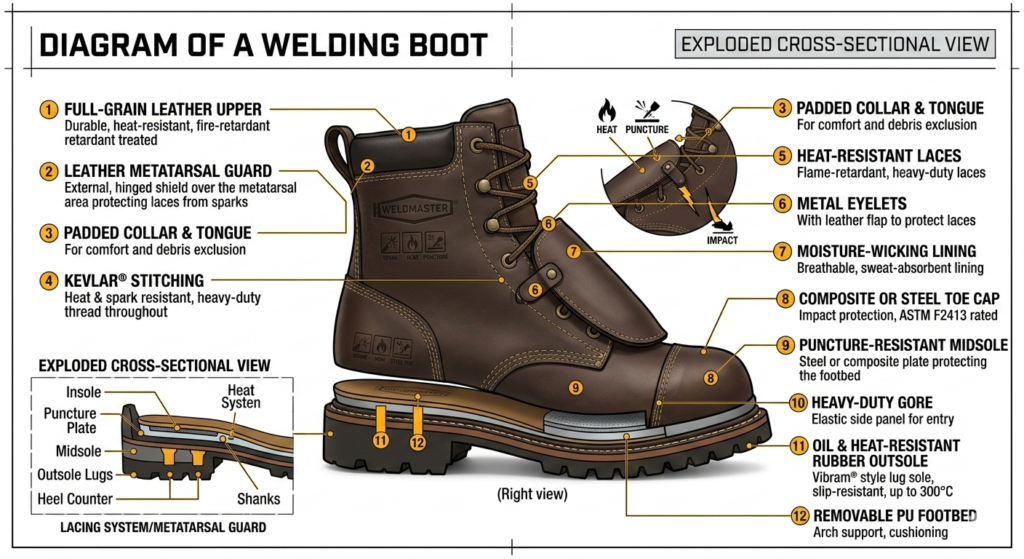
A proper pair of welding boots typically includes:
- Heat-resistant outsoles (rated to at least 300°F–1000°F depending on the model)
- EH (Electrical Hazard) protection — secondary insulation against open electrical circuits up to 600 volts
- Minimal or recessed lacing to reduce spark catch points
- Full-grain or nubuck leather uppers that resist abrasion and repel sparks better than synthetic materials
- Steel or composite toe caps for impact and compression protection
- Metatarsal guards (external or internal) for the best spark and impact protection at the top of the foot
Now, do you need every single one of these features? That depends on your welding environment. A TIG welder in a clean shop has different needs than a stick welder on a pipeline job in January. That’s exactly what this guide is going to help you figure out.
The 5 Best Welding Boots of 2026
1. Wolverine Men’s Core Floorhand 6″ — Best Budget-Friendly Welding Work Boot
Best for: Shop welders, beginners, and anyone who needs solid everyday protection without spending a fortune.
If you’re new to welding or just need a dependable workhorse that won’t break the bank, the Wolverine Floorhand is a seriously hard boot to beat. Wolverine has been making boots in Rockford, Michigan, since 1883 — these guys know leather — and the Floorhand line is one of their most beloved everyday work boots for good reason.
The Floorhand is built on a waterproof full-grain leather upper with a breathable, moisture-wicking mesh lining inside. That combination means your feet stay dry whether the moisture is coming from outside rain or your own sweat after a long shift. The rubber outsole is slip-resistant, which matters when you’re navigating oily shop floors.
What really makes this boot work for welding is the ASTM F2413-18 M/I/C EH-rated steel toe. It’s been tested to resist impact, compression, and electrical hazards up to 600 volts. The cement construction keeps it lightweight, and the removable full-cushion footbed molds to your foot over time, which welders who clock 10-12-hour days will seriously appreciate.
The Floorhand isn’t a dedicated welding boot — it doesn’t have a metatarsal guard or heavily reinforced upper stitching with Kevlar — so if you’re doing heavy fabrication with lots of spatter, you’ll want something with more protection. But for general shop work, MIG welding, or lighter-duty applications? This one hits above its weight class.
Key Specs:
| Feature | Detail |
|---|---|
| Upper | Waterproof full-grain leather |
| Toe Cap | Steel toe, ASTM F2413-18 M/I/C EH |
| Outsole | Slip-resistant rubber |
| Lining | Moisture-wicking mesh |
| Construction | Cement construction, nylon shank |
| Met Guard | No |
Pros:
- Great value
- EH rated
- Waterproof
- Comfortable right out of the box
- Lightweight for a steel-toe boot
Cons:
- No met guard
- No Kevlar stitching
- Not designed for heavy spatter environments
2. SAFETOE Men’s Composite Toe Welding Boot (Fire & 300°C Heat Resistant) — Best Dedicated Welding Boot for Heat Resistance
Best for: Production welders, fabrication shops, anyone dealing with consistent high-heat spatter and slag.
If heat protection is your number one priority, the SAFETOE welding boot is purpose-built for exactly that. This is one of the few boots on this list that’s literally called a welding boot — and it earns that label.
The SAFETOE features a 300°C (572°F) heat-resistant dual PU/rubber outsole, which is a step up from many general work boots that cap out at lower temperatures. The outsole is paired with fire-resistant stitching — even the thread used to hold this boot together is designed not to melt under welding conditions. That’s a detail most people overlook until they’ve watched a pair of regular boots fall apart from the inside out.
The upper is made from 100% top-layer nubuck cow leather, which offers a solid balance of durability, flexibility, and natural resistance to sparks and heat. Inside, you’ll find a lightweight memory foam insole with SAFETOE’s Four Layer Rebound (4LR) technology — a bit of a marketing term, but the ergonomic cushioning is genuinely effective for long-shift comfort.
The toe cap is composite, which means no heat conductivity issues that you’d theoretically get with a steel toe in extreme heat environments. It’s also CE (EN ISO 20344:2011) and ASTM F2413-18a heat-resistant certified. A Kevlar anti-puncture midsole adds underfoot protection against sharp debris on the shop floor.
The SAFETOE also comes in a metatarsal-guard version (reviewed separately below) if you need even more coverage. For the standard model, it’s a solid, purpose-designed welding boot at a competitive price point.
Key Specs:
| Feature | Detail |
|---|---|
| Upper | 100% nubuck cow leather |
| Toe Cap | Composite toe (ASTM F2413-18a) |
| Outsole | 300°C heat-resistant dual PU/rubber |
| Midsole | Kevlar anti-puncture |
| Certification | CE & ASTM certified |
| Met Guard | No (see Model 3 below) |
Pros:
- Exceptional heat resistance (300°C rated)
- Fire-resistant stitching
- Composite toe
- Kevlar midsole
- Great value for a purpose-built welding boot
Cons:
- Relatively new brand with less heritage than Timberland or Wolverine
- Sizing can run slightly narrow
3. SAFETOE Composite Toe Welding Boot with Metatarsal Protection — Best Welding Boot for Full Foot Protection
Best for: Structural welders, heavy fabrication, job sites where metatarsal injury risk is real.
If you’ve ever had a piece of steel plate or a grinding disc land on the top of your foot, you understand why metatarsal guards exist. The bones in the upper foot — your metatarsals — are surprisingly vulnerable to crush injuries, and a standard steel or composite toe only protects the toes themselves. The metatarsal guard extends that protection back along the upper foot.
This SAFETOE model takes everything that makes the standard composite toe version great and adds an integrated metatarsal guard. It carries the same 300°C heat-resistant outsole, nubuck cow leather upper, Kevlar anti-puncture midsole, and composite toe cap — plus the added met guard coverage that demanding welding environments often require.
The certification stack here is solid: CE (EN ISO 20344:2011-8.7) and ASTM F2413-18a heat-resistant approved. The wide fitting toe box is a genuine relief for welders whose feet swell during long shifts, and the memory foam insole makes the all-day comfort story hold up in practice, not just on a spec sheet.
If your shop requires or recommends metatarsal protection — and a lot of structural steel shops do — this is the SAFETOE to reach for. The price bump over the standard model is minimal for the additional coverage you get.
Key Specs:
| Feature | Detail |
|---|---|
| Upper | 100% nubuck cow leather |
| Toe Cap | Composite toe (ASTM F2413-18a) |
| Outsole | 300°C heat-resistant dual PU/rubber |
| Met Guard | Yes — integrated metatarsal protection |
| Midsole | Kevlar anti-puncture |
| Certification | CE & ASTM certified |
Pros:
- Full foot protection, including metatarsals
- 300°C heat resistance
- Fire-resistant stitching
- Wide fit
- Ergonomic insole
Cons:
- Slightly bulkier than boots without a met guard,
- Similar brand-recognition caveats as the standard SAFETOE
4. Timberland PRO External Met Guard 8″ Waterproof Steel Toe (2024) — Best Premium Welding Boot
Best for: Professional welders and industrial workers who want maximum protection and don’t want to compromise on comfort or build quality.
If you’ve been welding for any length of time, you’ve probably heard someone at the shop swear by Timberland PRO. And the External Met Guard line is genuinely one of the best welding boot setups you can buy right now — premium materials, a serious certifications list, and enough comfort tech to survive a double shift.
The 2024 version of this 8-inch boot is built on Timberland PRO’s Ever-Guard leather — a proprietary, highly abrasion-resistant material that the brand claims is significantly more durable than standard full-grain leather. The stitching is heat-resistant, and the welt is Kevlar, which means the seams themselves won’t degrade under welding conditions. That’s a detail that separates real welding boots from boots that just look like welding boots.
The external metatarsal guard is hinged and ABS-constructed, which matters because a rigid met guard is a miserable thing to work in — especially if you’re squatting, crouching, or climbing. The hinged design flexes with your foot while still providing certified impact protection to your metatarsals.
The steel safety toe meets ASTM F2412-18a and F2413-18 I/C standards, and the full boot carries EH (electrical hazard) protection, met guard certification, and waterproof membrane certification (ASTM F1671-07). The outsole is Timberland PRO’s own heat-, oil-, slip-, and abrasion-resistant rubber compound.
Comfort-wise, the 24/7 Comfort System — Timberland PRO’s arch-support and cushioning platform — is genuinely impressive for an 8-inch work boot. Reviewers consistently note that these break in quickly and hold up well over time, with internal cushioning being the limiting factor before the leather or sole shows significant wear.
One honest note: these run a bit bulky. If you’re in tight spaces or doing detailed positioning work, the 8-inch height can feel restrictive. For most welders, though, that’s a fair trade for the level of protection you’re getting.
Key Specs:
| Feature | Detail |
|---|---|
| Upper | Ever-Guard abrasion-resistant leather |
| Height | 8 inches |
| Toe Cap | Steel toe (ASTM F2412-18a / F2413-18 I/C) |
| Met Guard | External hinged ABS metatarsal guard |
| Outsole | Heat-, oil-, slip-, abrasion-resistant rubber |
| Waterproof | Yes — ASTM F1671-07 certified membrane |
| EH Rating | Yes |
| Stitching | Kevlar welt and upper stitching |
Pros:
- Exceptional build quality,
- hinged external met guard,
- Ever-Guard leather,
- Kevlar stitching, waterproof,
- EH rated,
- 24/7 comfort system
Cons:
- Premium price point,
- Bulkier feel due to the 8-inch height and the met guard design,
- May not be ideal for tight or confined workspaces
5. Timberland PRO Direct Attach 6″ Insulated Waterproof — Best Welding Boot for Cold Weather and Outdoor Work
Best for: Pipeline welders, outdoor construction welders, and anyone working in cold or wet environments.
Not every welder works in a climate-controlled shop. Pipeline welders, structural steel workers, and outdoor construction welders deal with a completely different set of conditions — wet ground, cold weather, and environments where your feet can get soaked or frozen long before any spark becomes a hazard.
The Timberland PRO Direct Attach 6″ Insulated Waterproof is built for exactly that scenario. Inspired by Timberland’s original iconic yellow boot — the one that essentially invented the modern waterproof work boot category back in 1973 — this version is updated with modern protection technology while keeping the classic durability that made Timberland famous.
The upper is seam-sealed, premium waterproof leather with 200 grams of Thermolite insulation. For context, 200g is appropriate for cool to moderately cold conditions; if you’re in seriously frigid environments, you might want to look at the 8-inch version with 400g insulation. The Anti-Fatigue Technology PU footbed provides genuine shock absorption and energy return, which becomes noticeable around hour eight of a standing shift.
The steel toe is EH-rated and meets ASTM F2413 standards. The outsole is Timberland PRO rubber — heat-, oil-, slip-, and abrasion-resistant — with a lug pattern designed for real-world traction on uneven terrain, mud, and wet surfaces. The ReBOTL moisture-wicking lining (made from at least 50% recycled plastic) adds breathability and odor control.
This boot doesn’t have a metatarsal guard, so it’s not the choice for heavy industrial fab where that’s required or recommended. But for outdoor welding, where waterproofing and thermal comfort are the priority? It’s one of the best options in its price range.
Key Specs:
| Feature | Detail |
|---|---|
| Upper | Seam-sealed waterproof premium leather |
| Height | 6 inches |
| Toe Cap | Steel toe, ASTM F2413, EH rated |
| Insulation | 200g Thermolite |
| Outsole | Heat-, oil-, slip-, abrasion-resistant Timberland PRO rubber |
| Waterproof | Yes — seam-sealed |
| Met Guard | No |
| Footbed | Anti-Fatigue Technology PU |
Pros:
- Excellent waterproofing (seam-sealed)
- 200g insulation for cold weather
- Anti-Fatigue footbed
- EH rated, classic rugged build
Cons:
- No met guard
- 200g of insulation may be insufficient for very cold climates
- Not specifically optimized for high-spatter welding environments
Best Welding Boots Buyer’s Guide: What to Look For
Okay, so you’ve seen the picks. Now let’s talk about how to actually choose the right welding boots for your situation. Because the best boot for a pipeline welder in North Dakota in February looks completely different from the best boot for a MIG welder in a heated fabrication shop.
1. Toe Protection: Steel vs. Composite
Both steel and composite toes meet the same ASTM impact and compression standards, so neither is objectively “safer” in those terms.
- Steel toe is cheaper, more proven, and very durable. The old myth that steel can “cut your toes off” in an accident has been thoroughly debunked — a crush force strong enough to collapse a steel toe would cause serious injury regardless. The downside: steel conducts heat and cold, and it’s heavier.
- Composite toe (usually fiberglass, carbon fiber, or Kevlar-based) is lighter, doesn’t conduct heat or cold, and won’t set off metal detectors. It’s a solid choice for welding environments where the toe gets a lot of heat exposure.
For most welding applications, either works. If you’re doing anything with extreme heat near the toe — foundry work, certain pipeline scenarios — composite is the smarter call.
2. Metatarsal Guard: Do You Need One?
The met guard is probably the most important feature that casual buyers overlook. Your metatarsal bones are the long bones across the top of your foot, and they’re vulnerable to impact and crush injuries from falling objects or spatter buildup.
- External met guard (like on the Timberland PRO 40000) clips or integrates onto the outside of the boot. You can usually see it. The hinged versions offer better mobility.
- Internal met guard sits inside the boot and adds a layer of protection without changing the boot’s external profile.
Many industrial welding environments — structural steel shops, fabrication facilities, foundries — either require or strongly recommend met guard boots. Check your job site’s PPE requirements before you buy.
3. Heat Resistance: What the Numbers Mean
A boot’s heat-resistant outsole rating is one of the most important specs for welding, and manufacturers describe it in different ways:
- ASTM F2413-18 HR indicates heat-resistant certification
- Temperature ratings (like the SAFETOE’s 300°C) tell you the threshold the sole can sustain without significant degradation
- Timberland PRO’s rubber compound is rated to resist heat up to 500°F (260°C) in some configurations
For general shop welding, any boot with an ASTM-certified heat-resistant outsole is adequate. For high-heat environments with significant spatter and slag, you want explicitly high-temperature ratings.
4. EH Rating: More Important Than You Think
EH (Electrical Hazard) protection is a secondary defense against accidental contact with live electrical circuits. The outsole is constructed to resist current flow up to 600 volts under dry conditions.
Every welder should have EH-rated boots. This is non-negotiable. The good news is that most quality work boots include EH rating — just make sure you see “EH” on the spec sheet before buying.
5. Pull-On vs. Lace-Up: The Great Welding Boot Debate
This one comes down to sparks and convenience.
Laces are a genuine vulnerability in welding boots. Sparks and hot slag can land on laces and either burn through them or — worse — get trapped between the lace and the tongue, right against your skin. Many experienced welders either tuck their laces or cover them with spats (boot protectors) to mitigate this.
Pull-on/Wellington-style welding boots eliminate the lace problem entirely. They’re also faster to get on and off, which matters when you’re hot, tired, and done for the day. The downside is that pull-ons can feel less secure around the ankle and don’t allow for the custom-fit adjustability that lace-ups provide.
Verdict: For heavy spatter welding (stick, flux-core), pull-on is often the smarter choice. For general shop work or environments with lighter spatter, lace-ups are fine — just be conscious of your lace management.
6. Waterproofing: When You Need It and When You Don’t
If you’re exclusively working indoors on a dry shop floor, waterproofing is a nice-to-have but not critical. If you’re doing any outdoor welding, pipeline work, construction, or even just walking to and from your truck in rain or snow, waterproofing becomes essential.
Look for seam-sealed construction (not just “waterproof leather”) and ideally a waterproof membrane certification. Waterproof leather alone will eventually soak through; seam-sealed construction is a much more reliable long-term solution.
7. How Long Should Welding Boots Last?
Realistically, a quality pair of welding boots should last one to two years with daily use — longer if you maintain them properly. The things that typically kill a welding boot first:
- Outsole degradation from repeated heat exposure
- Upper cracking from dry leather and lack of conditioning
- Lace and seam failure from spatter damage
- Insole breakdown from accumulated sweat and compression
A few maintenance tips that extend boot life dramatically:
- Clean boots after every shift with a damp cloth — don’t let slag and debris bake into the leather
- Condition leather uppers monthly with a quality conditioner (mink oil, Bick 4, or similar)
- Replace insoles before they fully flatten out — your joints will thank you
- Check outsoles and stitching regularly; a separated sole is both a safety hazard and accelerates upper damage
8. What’s the Right Budget?
Here’s a rough breakdown of what your dollar gets you in welding boots:
- Under $100: Basic EH and steel-toe protection, probably decent for light-duty or student use. Don’t expect met guards, Kevlar stitching, or long-term durability.
- $100–$180: The sweet spot. Quality brands like Wolverine, SAFETOE, and entry Timberland PRO models live here. Real leather, solid safety certifications, and reasonable durability.
- $180–$300+: Premium territory. Full met guard systems, Kevlar stitching, high-end leather (like Ever-Guard), superior comfort systems, and boots built to last 2–3 years with care.
Don’t cheap out on boots if welding is your livelihood. Your feet are the foundation of your workday — literally.
FAQs: Best Welding Boots
Are pull-on welding boots better than lace-up boots for welding? They remove the lace-burn problem entirely, which is a real advantage in high-spatter environments. For general use, both work fine — just manage your laces or use spats if you go with lace-ups.
Can I weld in composite toe boots? Absolutely. Composite toe meets the same ASTM impact and compression standards as steel toe, and it actually has advantages in high-heat environments since it doesn’t conduct heat the way steel does.
What’s the difference between welding boots and regular work boots? Welding boots are designed with heat-resistant outsoles, minimal exposed stitching (or Kevlar stitching), fire-resistant uppers, and sometimes metatarsal guards. Regular work boots may share some of these features, but aren’t tested or certified for the specific hazards of welding.
How do I protect boot laces from sparks and slag? You can tuck laces, use lace protectors, wear spats/boot covers, or simply switch to a pull-on style boot. Many experienced welders also tape over laces with heat-resistant tape in heavy-spatter situations.
What are the best welding boots for beginners? The Wolverine Floorhand is a great starting point — EH-rated, waterproof, comfortable, and affordable enough that you’re not making a huge investment while you figure out what your work environment actually demands.
Final Thoughts
Your feet log serious mileage every shift. They deserve more than a $50 afterthought from the hardware store discount bin.
Whether you’re just starting out and the Wolverine Floorhand makes the most sense, or you’re a career welder who wants the full protection package of the Timberland PRO External Met Guard, there’s a boot on this list for you. And if heat resistance is your primary concern, the SAFETOE composite toe options punch well above their price — especially the metatarsal guard version for high-risk environments.
Take the buyer’s guide seriously. Match your boot to your actual working conditions. Maintain them properly. And replace them before they fail — not after.
Your future self (with comfortable, attached toes) will thank you.
Have a welding boot you swear by that didn’t make the list? Drop it in the comments — the best boots often come from word of mouth on the shop floor.