5 Best Welding Helmets for Beginners 2026 (Welder Tested)



Quick Comparison Table – Best Welding Helmets for Beginners
| Helmet | Type | Viewing Area | Sensors | Shade Range | Best For |
|---|---|---|---|---|---|
| Jackson Safety 20508 | Passive (Fixed) | Full face | N/A | Shade 10 fixed | Welding school, beginners learning proper technique |
| YesWelder LYG-M800H | Auto-darkening | 3.94″ x 3.66″ | 4 | 3/5-9/9-13 | Best all-around beginner AD helmet |
| ARCCAPTAIN Large View | Auto-darkening + work light | 3.94″ x 3.66″ | 4 | 4/5-9/9-13 | Dark work environments, triple-certified, magnifying lens users |
| YesWelder Flip-Up (Digital) | Auto-darkening + flip-up | 3.94″ x 2.34″ + side | 4 | 4/5-9/9-13 | Efficient workflow, frequent inspection |
| YesWelder Small Viewing Area | Auto-darkening + flip-up | 3.64″ x 1.67″ | 4 | 4/5-9/9-13 | Beginner Option with Smaller Viewing Area Lense |
Over the last 25 years, I’ve done a lot of welding and used many welding helmets. Some good, some not so good. In this article, I’m going to share my top five welding helmets for beginners and explain why I would consider them.
If you just want me to cut straight to the point, check out the comparison guide at the top of this article. If you want a more in-depth reason, keep reading.
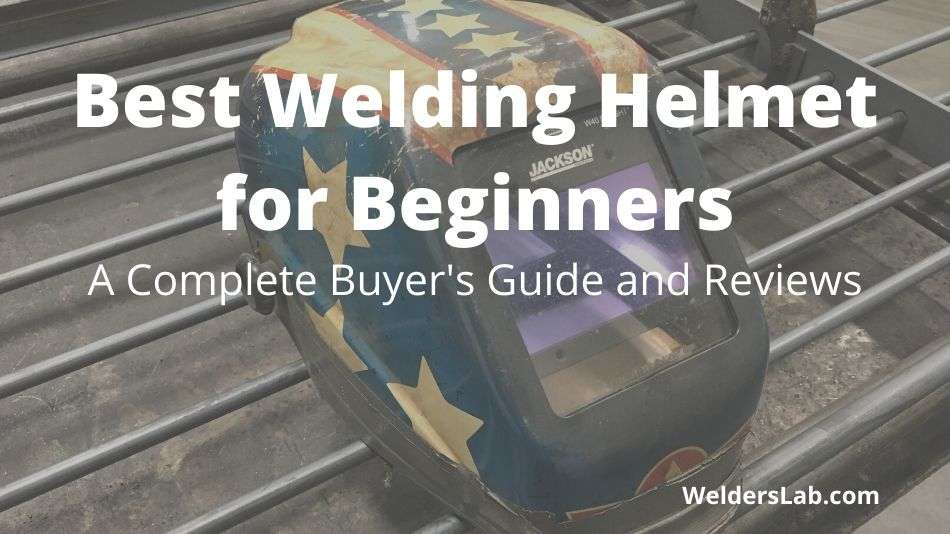
5 Best Welding Helmets for Beginners Reviewed by a Real Welder
I’ve personally tried all of these options and found them to be the best welding helmets for beginners. In fact, option one is the same helmet I still use to this day.
#1 Jackson Safety HLX 100 Welding Hood – Best Fixed Shade Helmet
- LIGHTWEIGHT WELDING HOOD – Jackson Safety’s HLX 100 Welding Helmet features a durable, lightweight design, weighing only…
- MINIMIZE TOP HEAVINESS – Sleek, balanced design minimizes top-heavy effect often felt from welder’s “bob”
- INCLUDES – Cover plate and shade 10 polycarbonate filter; Patented 370 Speed Dial ratcheting headgear with “Qwik-Fit” re…
If you’ve spent any time around welding forums or trade schools, you’ve heard the classic debate: auto-darkening vs. passive. Many experienced welders — and even some instructors — still swear by passive helmets, and the Jackson Safety 20508 is exactly the kind of hood they’re talking about.
This is a fixed-shade helmet with a W10 (shade 10) lens and Jackson’s signature HLX (ultra-lightweight) shell. It’s simple, durable, and incredibly comfortable for extended sessions. The 370 Speed Dial ratcheting headgear is honestly one of the best headgear systems at any price point — quick to adjust, secure, and it doesn’t leave your neck screaming after a few hours.
The shell is made from Jackson’s proprietary fiberglass-reinforced nylon, making it light yet impact-resistant. It comes with the “Heavy Metal” graphic design, which looks legitimately cool in the shop.
Specs at a glance:
- Type: Passive (fixed shade)
- Shade: W10 (fixed); however, you can always upgrade to a higher shade
- Shell: HLX lightweight nylon
- Headgear: 370 Speed Dial ratcheting system
- Compliance: ANSI Z87.1+
Pros
- Featherlight comfort. The HLX shell is one of the lightest on the market. You can wear this for a 10-hour shift and barely notice it’s there.
- Premium headgear included. The 370 Speed Dial system is a genuine standout — most budget helmets come with headgear that feels like an afterthought. This one doesn’t.
- Zero electronics to fail. No batteries, no sensors to misfire, no delay settings to fiddle with. The shade is always on. For beginners, this eliminates one variable from the learning curve.
- Instructor-approved. Many welding schools and trade programs actually recommend or require passive helmets for beginners because they force you to develop proper arc-starting technique.
- Compatible with Jackson True Sight II insert. If you ever want to upgrade the lens quality, the HLX shell accepts Jackson’s premium ADF inserts.
Cons
- Fixed shade 10 can be too dark for low-amp work. If you’re TIG welding at sub-100 amps on thin stainless, shade 10 might make the puddle hard to track. You may want to pick up a shade 9 or even shade 8 lens separately.
- Flip-up required between welds. Every time you need to see your workpiece clearly, you’re flipping the hood up manually. For high-volume work with lots of tacks and repositioning, this gets old fast.
- No grinding mode. A fixed passive lens is completely opaque when the arc isn’t struck, so you can’t use it for grinding without swapping to a different shield.
- Headgear adjustment can be finicky out of the box. Some users report needing to reconfigure the headgear mounts before the helmet will flip up high enough to see the work table clearly.
Who It’s Best For
This is the ideal first helmet for welding school students and complete beginners who are just starting to learn MIG or stick. It’s also a great pick for anyone who does occasional hobby welding and wants something dead-simple, comfortable, and built to last. If your instructor recommends a passive helmet — or if you just want zero electronic headaches — this is the one to get.
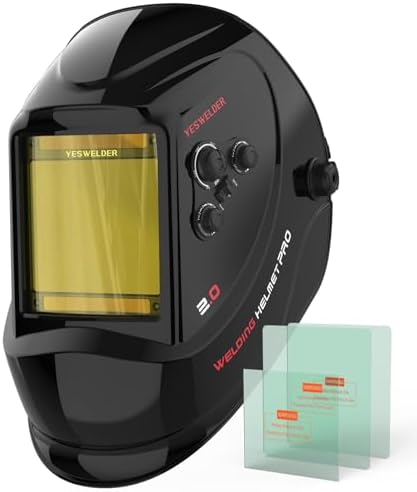
2. YESWELDER Large View Auto Darkening Welding Helmet – Best Beginner Auto Dark Helmet
- LARGE VIEW WITH TRUE COLOR CLARITY: See more of the weld puddle, joint edges, and work position through a wide 3.93″ x 3…
- FAST AUTO DARKENING WITH 4 ARC SENSORS: Built with 4 arc sensors and a 1/30,000-second switching speed to support respon…
- VERSATILE SHADE CONTROL FOR DAILY SHOP USE: Adjustable DIN 3/5-9 and 9-13 shade settings give you flexible switch betwee…
The YesWelder LYG-M800H is the helmet that converted a ton of hobbyists and budget-conscious beginners from passable auto-darkening units to actually good ones. It features a massive 3.94″ x 3.66″ viewing window — that’s genuinely large, even by premium helmet standards — combined with true color technology and a 1/1/1/1 optical clarity rating.
For context, that 1/1/1/1 rating means the lens scores the highest possible marks across optical clarity, light diffusion, angle dependence, and homogeneity. You used to only find that in $200+ helmets. The M800H delivers it in the sub-$100 range, which is still kind of wild.
It runs on solar power with a lithium battery backup, has 4 arc sensors for reliable triggering even in confined spaces, and offers a wide shade range (3/5-9/9-13) that covers MIG, stick, TIG, plasma cutting, and grinding.
Specs at a glance:
- Type: Auto-darkening
- Optical Clarity: 1/1/1/1
- Viewing Area: 3.94″ x 3.66″
- Arc Sensors: 4
- Shade Range: 3/5-9/9-13
- Power: Solar + lithium battery
- Compliance: ANSI Z87.1, CE
Pros
- Huge, clear viewing window. More real estate to see your puddle means better control, especially when you’re still learning the technique. The true color view (no green tint) makes everything look more natural and easier to read.
- 1/1/1/1 optical clarity at a budget price. This is the specification that separates good helmets from great ones, and the M800H nails it without the premium price tag.
- 4 arc sensors. More sensors mean the helmet darkens reliably even when you’re welding in awkward positions where part of the arc might be partially obstructed.
- Wide shade range. Whether you’re MIG welding mild steel, stick welding on a farm repair, or TIG welding aluminum, this helmet’s range covers you.
- Comes with accessories. The package typically includes a storage bag, replacement lenses, and a spare battery — solid value right out of the box.
Cons
- Feels slightly plasticky. The shell and build quality is serviceable but not premium. You can tell where they cut costs compared to a Miller or Lincoln hood. It won’t fall apart, but it doesn’t feel like a $300 helmet.
- No flip-up design. For frequent tacking or work that requires lifting the hood constantly, the standard flip-up shell can interrupt your workflow more than you’d like.
- Solar charging only works under bright light. The solar panel assists but doesn’t fully charge the battery. In low-light indoor environments, battery life becomes more of a concern.
- Headgear adjustment has a learning curve. Getting the fit dialed in takes a few minutes of fiddling. It’s adjustable in four ways (headgear top, tightness, angle, distance), but the knobs can feel stiff at first.
Who It’s Best For
This is the best all-around auto-darkening helmet for beginners who want professional-grade optics without a professional-grade price. It’s equally at home in a home garage, a community college welding class, or a small fabrication shop. If you’re doing MIG, stick, or learning TIG and want the clearest possible view of your puddle without spending over $100, the M800H is hard to beat.
#3 ARCCAPTAIN Large View 3.94″ x 3.66″ True Color Auto Darkening Welding Helmet with Light
- WITH LED WELDING LIGHT: This welding helmet comes equipped with a USB-powered LED light on top, offering two brightness …
- FASTER AUTO DARKENING: Upgrade to high-end auto-darkening lenses with 4 premium arc sensors, switching from light to dar…
- SUPER LARGE SCREEN: 3.94” x 3.66″ super large visible screen welding hood, featuring top-tier 1/1/1/1 optical clarity le…
The ARCCAPTAIN Large View Helmet has quietly become one of the most talked-about value picks in the beginner helmet space, and it’s not hard to see why. It matches the YesWelder M800H’s massive 3.94″ x 3.66″ viewing window spec-for-spec, delivers 1/1/1/1 true color optics, runs 4 arc sensors, and covers the same wide shade range — but adds one feature none of the others on this list have: a built-in work light.
That light is more useful than it sounds. Plenty of welding happens in dark corners of garages, under vehicles, inside frames, or in dim shop environments. Having an integrated light that illuminates your workpiece when the ADF visor is up — without needing a separate clip-on light or holding a flashlight in your teeth — is a genuine quality-of-life feature, especially for beginners still getting their positioning dialed in.
ARCCAPTAIN is a brand that’s been manufacturing digital welding equipment since 2003, with products tested through TÜV and CSA witness laboratories. The helmet shell is built from durable shock- and flame-resistant PP material, and it’s certified to ANSI Z87.1, CE (EN379), and CSA Z94.3 standards — one of the few budget helmets to carry all three certifications.
Specs at a glance:
- Type: Auto-darkening
- Optical Clarity: 1/1/1/1
- Viewing Area: 3.94″ x 3.66″
- Arc Sensors: 4
- Shade Range: 4/5-9/9-13
- Power: Solar + CR2450 lithium battery
- Special Feature: Built-in work light
- Weight: ~2 lbs
- Compliance: ANSI Z87.1, CE (EN379), CSA Z94.3
Pros
- Built-in work light is a genuine differentiator. No other helmet on this list includes one. When you flip up the visor to check your work or reposition your torch in a dimly lit space, that light makes a real difference. It’s the kind of feature you don’t know you need until you have it.
- Same massive viewing area as the M800H. The 3.94″ x 3.66″ window is class-leading at this price point, giving you a wide, unobstructed view of your weld puddle and surrounding work area.
- Triple-certified safety compliance. ANSI Z87.1 + CE + CSA Z94.3 is a stronger certification profile than most budget helmets. If you’re working across different environments or need CSA compliance for Canadian job sites, this is notable.
- 4 arc sensors + 1/1/1/1 optics at a budget price. You’re getting the same sensor count and optical clarity as helmets costing significantly more.
- Magnifying lens compatible. If you wear glasses or struggle with close-up detail work, the helmet accepts a magnifying cheater lens (sold separately) — a practical feature for beginners with vision correction needs.
- Lightweight at ~2 lbs. Despite the added light feature, the shell stays around 2 lbs, which is comfortable for extended practice sessions.
Cons
- Work light battery life isn’t infinite. The light draws from the same solar + CR2450 battery system as the ADF lens. In long sessions, heavy light use may slightly accelerate battery drain — keep a spare CR2450 on hand.
- External controls only. Shade, sensitivity, and delay adjustments are handled via external knobs and buttons on the shell rather than a digital display. Fine once you learn them, but slightly less intuitive than a digital interface for absolute beginners.
- Shell build quality is functional, not premium. Like the YesWelder helmets, the PP shell does its job well, but doesn’t have the same feel as a Miller or Lincoln hood. This is completely normal at this price point.
- Light brightness isn’t adjustable. The work light is on or off — no dimming. In very bright environments, this is a non-issue, but in pitch-dark spaces, it could be slightly harsh.
- Shade range starts at 4, not 3.5. If you need very low-shade plasma cutting or light grinding in the 3-4 range, check your specific workflow needs before buying.
Who It’s Best For
This is the best pick for beginners who weld in darker environments — garages with poor overhead lighting, under vehicles, in tight spaces, or anywhere you’re constantly fighting to see your workpiece clearly. It’s also a smart choice for anyone who values maximum safety certification coverage (ANSI + CE + CSA) or who needs magnifying lens compatibility for vision correction. If the YesWelder M800H is your head-to-head competition and you’re on the fence, the built-in work light may be the tiebreaker that decides it for you.
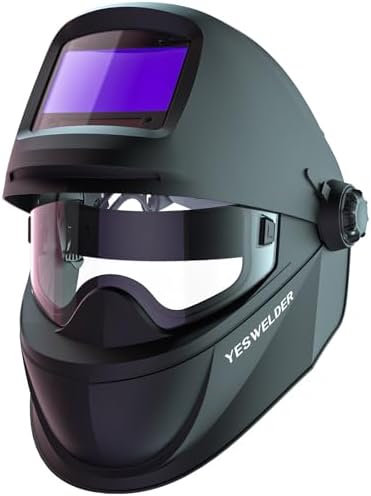
#4 YesWelder Flip-Up Auto-Darkening Welding Helmet with Digital Lens
- Perfect Eye Protection: Auto darkening filter switches from light to dark in 1/25000 sec, eliminating dangerous arc flas…
- Smart Bluetooth Control: Remotely adjust sensitivity/delay/shade levels. Customize settings without removing gloves – id…
- Wide Applications: Shade range 4/5-9/9-13 covering most common welding and plasma cutting processes, great For TIG MIG M…
Here’s where things get genuinely clever. This YesWelder model takes everything good about a standard auto-darkening helmet and adds an ergonomic flip-up design — meaning the ADF visor flips up independently, leaving a clear polycarbonate face shield in place underneath. So when you need to inspect your work, adjust your clamps, or grab a piece of material, you flip up the darkening lens without removing the helmet entirely.
This is a feature you typically pay $300+ for on big-brand helmets like 3M or Miller flip-up models. YesWelder brought it down to a fraction of that cost. The digital welding lens allows very precise shade, sensitivity, and delay adjustments, and it supports memory settings for different applications.
The shell is high-impact-resistant nylon rated from 14°F to 149°F, and the main viewing window measures 3.94″ x 2.34″ with 1/1/1/1 optical clarity. It also features side DIN 5 windows for peripheral awareness — a useful safety bonus when you’re working around other people.
Specs at a glance:
- Type: Auto-darkening with flip-up visor
- Optical Clarity: 1/1/1/1 (main screen)
- Viewing Area: 3.94″ x 2.34″ (plus side DIN 5 windows)
- Arc Sensors: 4
- Shade Range: 4/5-9/9-13
- Power: Solar + rechargeable battery (USB-C)
- Shell Rating: 14°F to 149°F
Pros
- Flip-up design is a genuine workflow game-changer. No more lifting and resetting the whole helmet between passes. Flip up, check your work, flip back down. This alone saves significant time and frustration, especially for beginners still getting their positioning dialed in.
- Clear face shield stays in place. Your face is always protected. Even with the ADF visor up, the underlying clear shield protects against spatter, debris, and grinding sparks.
- Side DIN 5 windows. Peripheral vision is genuinely useful for situational awareness in a busy shop or when working near other people.
- Digital lens with memory settings. Save your preferred settings for MIG, TIG, stick, or grinding — no re-dialing every time you switch processes.
- USB-C rechargeable. No hunting for specialty batteries. Plug it in like your phone.
Cons
- Heavier than standard ADF helmets. The flip-up mechanism and clear face shield add weight. If neck fatigue is a concern for you, factor this in for long sessions.
- Smaller main viewing area than the M800H. At 3.94″ x 2.34″, the primary ADF window is noticeably narrower than the M800H’s 3.66″ height. You get side windows to compensate, but the main weld view is less panoramic.
- More moving parts = more potential failure points. The flip mechanism is durable, but it’s an added mechanical component that a standard helmet doesn’t have.
- Learning curve with settings. The digital lens has more adjustment options than a basic helmet, which is great once you know what you’re doing — but can be confusing for absolute beginners.
Who It’s Best For
This helmet is perfect for intermediate beginners who are past their first few welds and want a more efficient workflow. It’s also fantastic for DIYers who do a mix of welding and grinding in the same session, or anyone who works on detailed projects where you need to frequently inspect your welds up close. If you hate constantly lifting and repositioning your helmet, this flip-up design will immediately make your sessions more enjoyable.
#5 YesWelder LYG-L600A True Color Solar-Powered Auto-Darkening Welding Helmet – Best For a Tight Budget
- Wide Application Range: Shade 3.5/9-13 supports TIG, MIG, MMA/ARC and Grind, and the helmet accommodates magnifying lens…
- True Color Clear View: A 3.64″ x 1.67″ viewing area with 1/1/1/1 optical clarity delivers a true color view for impnrove…
- Advanced Eye Protection: Features a blue light blocking outer lens to help reduce harmful high-energy blue lighit exposu…
The YesWelder LYG-L600A is the entry point into the YesWelder auto-darkening lineup — compact, straightforward, and focused on delivering true color optics at the most accessible price. It features blue light blocking technology, which is a legitimate and underrated feature that reduces eye strain during long welding sessions by filtering the most harmful portion of the blue light spectrum.
It’s a simpler helmet than the others on this list — 2 arc sensors instead of 4, a smaller viewing area (3.64″ x 1.67″), and no flip-up mechanism. But it still delivers 1/1/1/1 optical clarity with true color view, a wide shade range (3.5/9-13), grind mode, and all the essential auto-darkening adjustments (sensitivity and delay).
For a beginner who just needs a solid, no-frills auto-darkening helmet to get started, this one hits the sweet spot between capability and cost.
Specs at a glance:
- Type: Auto-darkening
- Optical Clarity: 1/1/1/1
- Viewing Area: 3.64″ x 1.67″
- Arc Sensors: 2
- Shade Range: 3.5/9-13
- Power: Solar + lithium battery
- Special Feature: Blue light blocking lens
- Compliance: ANSI Z87.1, CE
Pros
- Blue light blocking is a real benefit. Prolonged welding exposes your eyes to high-energy blue light, and having a lens that filters this out helps reduce fatigue during longer practice sessions — something beginners put in a lot of.
- 1/1/1/1 true color optics in an entry-level package. Most helmets at this price point drop to 1/1/1/2 or lower. Getting the top optical clarity rating here is a genuine value add.
- Lightweight and comfortable. At around 1.85 lbs with the ergonomic headgear, it’s easy to wear for extended practice sessions without neck fatigue.
- Grind mode included. Flip to grind mode and the helmet clears up to DIN 4 for grinding work without switching to a separate face shield. Handy.
- Simple to operate. Two sensors, external controls, and a no-fuss interface means beginners can focus on welding rather than navigating settings menus.
Cons
- Only 2 arc sensors. In tight corners or positions where the arc might be partially blocked, 2 sensors can occasionally fail to trigger as reliably as a 4-sensor helmet. Not a dealbreaker for most beginner applications, but worth knowing.
- Smaller viewing window. The 3.64″ x 1.67″ viewing area is noticeably smaller than the M800H’s massive window. You’ll see less of your work area, which matters more as your work gets more detailed.
- Solar panel assists, but doesn’t charge. The solar panel extends battery life, but can’t fully charge the battery. Keep the replacement battery on hand.
- No flip-up design. Standard flip-up shell only.
- Less headgear adjustability. Four adjustment points are present, but some users find the knobs a bit stiff initially.
Who It’s Best For
This is the best welding helmet for absolute beginners on a tight budget who want auto-darkening without compromising on optical quality. It’s ideal for someone taking their first welding class, doing occasional repairs around the house, or just getting into MIG or stick welding as a hobby. If budget is your primary constraint and you want a true color, ANSI-compliant helmet that works reliably, this is your starting point.
Buyer’s Guide: How to Choose Your First Welding Helmet
You’ve seen the picks. Now here’s the framework to make sure you’re choosing the right one — or to evaluate any other helmet you come across.
1. Passive vs. Auto-Darkening: Which Should a Beginner Choose?
This is the first and most fundamental question.
Passive helmets have a fixed-shade lens that’s always dark. You flip the hood down right before striking the arc — often called “the head bob.” They’re simpler, cheaper, and have zero electronics to fail. Many welding instructors prefer them for beginners because they teach you proper arc-starting technique from the jump. The downside? They require that head-bob motion, which gets tiresome for high-volume work, and you’re stuck at one shade level.
Auto-darkening helmets (ADF) detect the arc with sensors and darken the lens electronically in milliseconds — typically 1/25,000 of a second or faster. You position your electrode or gun, lower the hood, and strike — all in one motion. They’re more versatile across processes and shade levels. The trade-off is batteries, sensors that can occasionally misfire, and a higher price for quality optics.
For most beginners in 2026, a quality auto-darkening helmet is the better choice. The technology has matured, and you can get excellent true color optics and reliable darkening for under $100. The exception: if your instructor specifically requires a passive helmet, go with the Jackson Safety #1 pick above.
2. Optical Clarity Rating: Don’t Skip This One
The optical clarity rating is expressed as four numbers, like 1/1/1/1 or 1/1/1/2. Each number represents a different optical test (optical clarity, light diffusion, angle dependence, and homogeneity), and lower numbers are better. A 1/1/1/1 rating means the lens performs at the highest level across all four categories.
Why does this matter? Because a lower-clarity lens (like 1/2/1/2) makes the weld puddle look hazy, distorted at angles, or uneven in shade — all of which make it harder to see what you’re doing and put more strain on your eyes. For a beginner still learning what a healthy weld puddle looks like, poor optical clarity adds unnecessary difficulty.
Look for 1/1/1/1 optical clarity. Every helmet on this list delivers it, which is part of why they made the cut.
3. Viewing Area Size Matters More Than You Think
A bigger viewing window gives you more spatial context around your weld — you can see where you’re headed, what’s adjacent to your bead, and track your travel angle more easily. The YesWelder M800H’s 3.94″ x 3.66″ window is genuinely large and makes a real difference when you’re learning.
Smaller windows (like 3.64″ x 1.67″ on the LYG-L600A) work fine for basic welding but can feel claustrophobic when doing detailed work. As a beginner, more viewing area is almost always better.
4. Arc Sensors: 2 vs. 4
Sensors detect the arc and trigger the auto-darkening filter. 4 sensors is better than 2 for beginners because you’re more likely to accidentally obstruct the arc from the sensor’s line of sight when you’re still figuring out positioning and torch angles. With 4 sensors positioned around the lens, you get reliable darkening even from awkward positions.
2-sensor helmets work fine for most basic welding, but if your budget allows, go with 4.
5. Shade Range: Know What You Need
Different welding processes require different shade levels for eye protection. Here’s a quick reference:
| Process | Recommended Shade |
|---|---|
| MIG (short-circuit, light) | 10 |
| MIG (spray arc, heavy) | 11-13 |
| Stick (SMAW) | 10-12 |
| TIG (low amp, thin material) | 8-9 |
| TIG (high amp) | 10-12 |
| Plasma cutting | 7-9 |
| Grinding | 3-5 (clear or very light) |
For most beginners doing MIG or stick, a shade range of 9-13 covers you well. If you’re learning TIG welding on thin material, you’ll want to go down to shade 8 or 9, so make sure your helmet’s range includes that.
6. Weight and Comfort for Long Practice Sessions
Beginners spend a lot of time under the hood — running beads, practicing restarts, grinding, re-doing welds. Neck and shoulder fatigue is real, and a heavy helmet makes practice sessions miserable.
Look for helmets under 2 lbs. All five helmets on this list are in a comfortable weight range. Also check that the headgear has multiple adjustment points (top, tightness, angle, and front-to-back distance) so you can get a secure, comfortable fit without hot spots.
7. ANSI Z87.1 Compliance: Non-Negotiable
Any welding helmet you buy for use in the US should meet ANSI Z87.1 safety standards. This certification means the lens and shell have been tested to withstand impact and block harmful UV and infrared radiation. Every helmet on this list is ANSI Z87.1 compliant. Don’t buy a helmet that isn’t — no matter how cheap or good-looking it is.
8. Features Worth Having vs. Features You Can Skip
Worth having:
- Grind mode (clears the lens to DIN 3-5 for grinding without removing the helmet)
- Adjustable sensitivity (helps avoid false triggers from bright shop lights)
- Adjustable delay (controls how long the lens stays dark after the arc extinguishes)
- Solar + battery backup (ensures consistent power)
Nice but not essential for beginners:
- Bluetooth remote control (useful but overkill for single-process starters)
- LED work light (helpful for dark environments but adds weight)
- Panoramic side windows (nice for awareness but not required)
Can safely skip:
- Extremely large lens covers (add weight, often more marketing than function)
- Exotic graphic designs (unless that’s important to you, which is totally valid)
Starting your welding journey is exciting — and picking the right helmet is one of the best decisions you can make early on. A good helmet doesn’t just protect your eyes; it actively helps you weld better by giving you a clear, accurate view of your puddle.
Here’s the quick cheat sheet:
- Learning at school / need passive: Go with the Jackson Safety 20508 (#1)
- Best auto-darkening under $100: Go with the YesWelder M800H (#2)
- Dark workspace / need a work light: Go with the ARCCAPTAIN Large View (#3)
- Want a flip-up workflow: Go with the YesWelder Flip-Up Digital (#4)
- Budget auto-darkening pick: Go with the YesWelder LYG-L600A (#5)
Any of these will serve you well. Start welding, make your mistakes, learn from them — your helmet’s job is just to make sure your eyes are still in good shape when you do.